
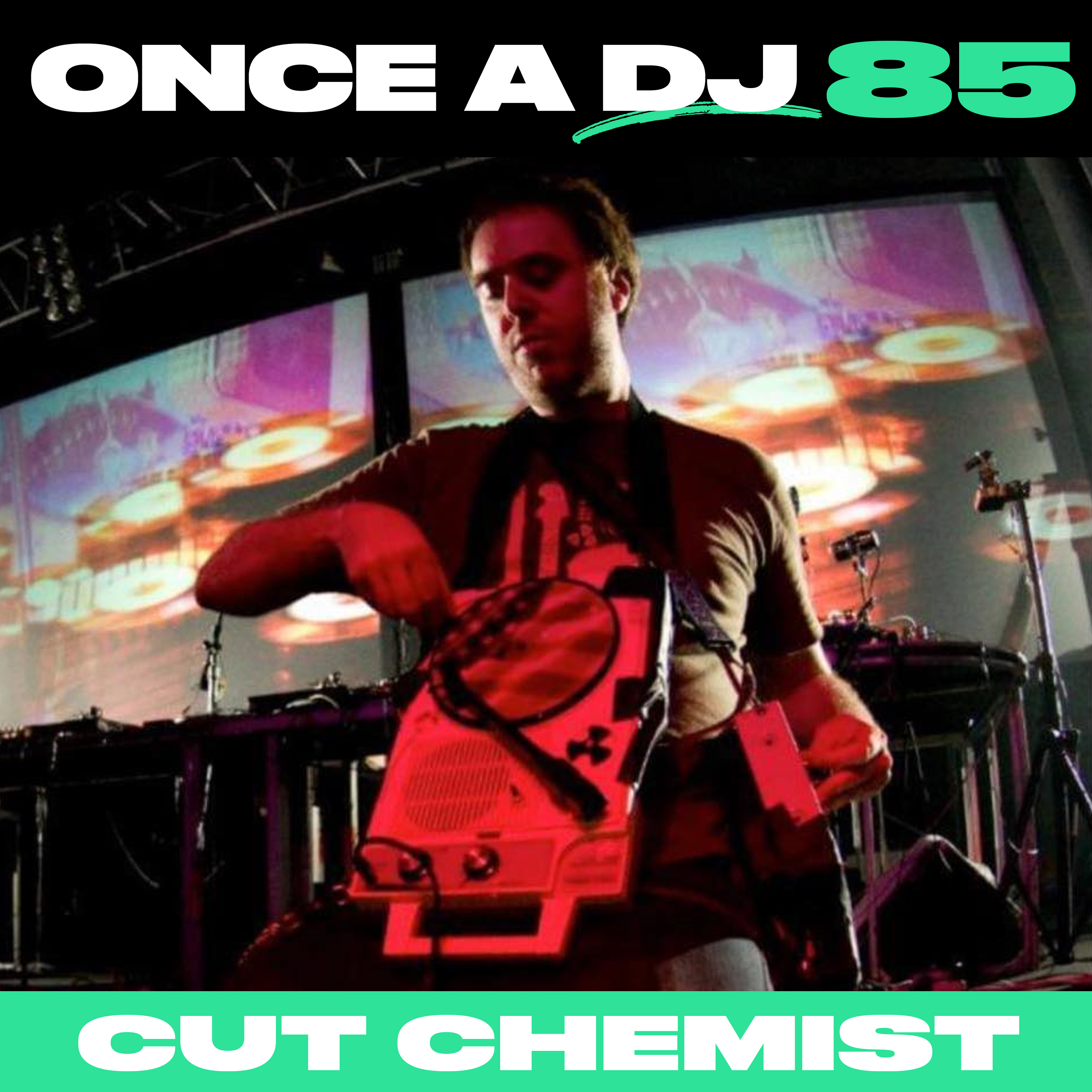
Cut Chemist has been on my list since the day I started this podcast, so getting him on for Episode 85 was a real full-circle moment. He’s someone whose records genuinely shaped how I dig and how I think about putting samples together, and across this conversation he traces the whole arc — from kicking along to a Bobby Darin concert in the womb, to a McDonald’s straw on a snare drum, to Star Wars soundtracks, to the moment hip hop landed for him in 1983.
We get deep into the Hollywood scene that raised him, the Rhino Records parking-lot quarter bins where he and his friends amassed beats nobody had touched, and the Jungle Brothers album that made him realise he could make “a record made out of records.”
From Unity Committee into Jurassic 5, sharing the production chair with Nu-Mark, the all-45s leap into Brain Freeze with DJ Shadow, the solo tightrope of The Audience’s Listening, and right up to his candlelit listening parties now — this one’s a masterclass in following the unfamiliar. It’s long, it’s nerdy in all the right places, and I couldn’t have asked for more from a guest who’s influenced me this much.
In this episode we cover:
- His earliest musical memories — parents, live drums, Carpenters and a deep sci-fi soundtrack obsession
- Discovering hip hop in 1983 via KDAY, breakdancing, graffiti and the elements one at a time
- Public Enemy, Bomb Squad and why Main Source is his production template
- The Jungle Brothers album that turned him into a sampler
- Learning gear the hard way — reel-to-reel, Roland S10, MPC, the Pro Tools learning curve
- Forming Jurassic 5 out of Unity Committee, and the east-coast heart in a west-coast city
- Pre-internet sample sleuthing and the legendary Rhino Records quarter bins
- First DJ gigs at 15, learning to cut, and the up-and-down fader style that became his own
- Qbert and the 1996 X-Men vs Scratch Pickles battle
- A digging philosophy: is the juice worth the squeeze?
- Sharing production with Nu-Mark, building Lesson 6, and breaking in Europe with Mr Format
- The Rare Equations mix, the Number Song remix and the all-45s origins of Brain Freeze
- Ozomatli, Brazilian and African digging, and constructing a set like a composition
- The Audience’s Listening at 20, The Garden in Brazil, and the Italy trip that changed everything
- The Good Life Cafe education and record shopping with Biz Markie
- Stable Sound, the Bandcamp subscription, and his candlelit psychedelic sound baths
- On Keb Darge, on Edan, and the Expert of None shows coming next
Transcript
Right, welcome back to Once A dj, everyone. Today’s guest, in my mind at least, needs no intro. It’s the.
The legend, 1/2 of the Jurassic 5’s production team, 1/2 of a lot of other projects, as well as the audience’s listening album. Mr. Cut chemist, how are you today?
Speaker B:Great, thanks for having me.
Speaker A:Yeah, yeah, no problem. You’ve been on the. You’ve been on the list basically since I started this. So a lot of questions.
You’ve influenced me and my DJing a lot, as I’d like to think you’ll find out through. Through this conversation.
And what I tend to do with all the guests is we just kind of look at where DJing came into your life and what your earliest sort of musical memories and inspirations were. So if you could just kind of start by. By sharing a bit of that,.
Speaker B:Trying to think. Okay, so my mom has this great story of being at a Bobby Darin concert while she was pregnant with me. And I was kicking to the beat, apparently.
So I guess you could say that was probably my first experience with music, being, you know, not born yet and listening to Bobby Darragh.
Speaker A:Yeah. Was your mum quite a big influence musically?
Speaker B:Both her and my dad, actually. My dad wrote music, he wrote poetry.
They would bring a lot of musicians over the house when I was really young, and so my first interaction with live instruments, particularly the drums. I remember seeing a drum set for the first time, and I must have been maybe three years old.
I remember I was in my pajamas and I had, like, a McDonald’s straw, and I was banging on the snare drum with it. That’s probably the very first recollection I have of anything musical is that moment.
Speaker A:So what about records, then? What sort of records were the earliest inspirations for Cook Chemistry?
Speaker B:Uh, Carpenters was a big one for me. Uh, that’s some. A record that my mom and dad used to play for me when I was not feeling well, and it would make me feel better.
What in particular, uh, what’s the song? Sing Out Loud. Sing it.
Speaker A:There was a good version of that on the Sesame street album.
Speaker B:Mm, okay. And that could have been the connection. You know, maybe I heard it in Sesame street or something, and that maybe wouldn’t make me feel comforted.
And then after that, it was Star wars soundtrack.
Speaker A:Do you mind me asking how old you are?
Speaker B:Oh, now I’m 53.
Speaker A:Yeah. So are you that sort of. When the first one came out, were you that generation that was just locked in straight away?
Speaker B:Yeah, I remember seeing it. I Was four years old and I saw First Run.
Speaker A:Was Darth Vader scary when you were four? Watching? I probably didn’t watch much Star wars until I was older.
Speaker B:Was he scary? You know, I don’t remember being scared. I remember being. I mean, you know, I bought the Darth Vader costume and everything.
So I think I looked at it like, wow, this is just really cool. Probably the scariest moment Darth Vader’s ever had for me was when he strangled that guy and threw him against the pillar of that ship.
Speaker A:Yeah, that’s pretty serious.
Speaker B:It’s like the debut of Darth Vader and he comes out swinging like that. That was scary. And then everything else just kind of got less scary for Darth Vader.
But no, the big moment for me was the opening when that never ending ship is going over your head. And I remember being in the theater vividly and experiencing that as a four year old and just going, what the fuck is going on right now?
When is this ship gonna end? It’s so big. And yeah, I became obsessed with the movie. I wanted to watch it all the time and I obviously couldn’t.
So when my parents bought me the soundtrack, I’d listen to it and imagine the movie while I was listening to the movie soundtrack.
Speaker A:Did you get the. Is it Bozo Mecco that did the like the disco version?
Speaker B:Oh, Miko M E C O. Yeah, Miko did a disco version. Got that one too. Yeah, played that a lot. You know, obviously that started my sci fi fetish. So Battlestar Galactica, Black Hole.
You know, I bought all these soundtracks and then also the story records so I can listen to the dialogue versions and yeah, I mean that was my first real like intimate relationship with records and music.
Because I would just sit in my room as whatever, six, five, you know, from probably like four to shit to now, you know, just listening to music on my own in my room, you know, that’s when that all started.
Speaker A:So when did you kind of broaden out? Was hip hop an early influence or was that a bit later?
Speaker B:Yeah, I didn’t get hip to the harp until 83, so I would have been 11.
Speaker A:So still in the infancy of hip hop then?
Speaker B:I mean, I got into it as it was crossing over into the mainstream and breakdancing was everywhere. I wasn’t hip, you know, I didn’t hear Rappers Delight, you know, on the radio or anything like that.
I think my first real, I mean the first song I ever heard with a rap in it was Blondie Rapture. But I don’t think it was until 83 that I heard things like Rocket and Freakazoid.
And not to say that those are, you know, they’re not rap songs, but they were considered hip hop because people were dancing in the street to them and Rocket had scratching. And, you know, obviously Rocket was the one that got me into wanting to be a scratch dj. And.
Yeah, and then my first real rap music that I heard was probably Run dmc.
Speaker A:Yeah. So was sort of. Was the sort of early hip hop not getting to the radio in LA then?
Speaker B:Not to say that it didn’t, but it. I didn’t find it until. Until 83. A friend of mine said, you know, there’s a lot of. There’s a lot of this music being played on this certain station.
And it was KD A Y. And yeah, they didn’t tell me that.
Speaker A:Until,.
Speaker B:I guess it was maybe the beginning of 84, actually, because I was already buying some of the records. I’m trying to think of, like, I had Rocket, I had maybe Buffalo Gals, and I had Midnight Star.
And then I’m trying to think of one other record I might have had at that time. And a friend of mine at school was like, yeah, they play a lot of this stuff on this AM station over here. So I started listening to it.
e time. I think it was around:Speaker A:So at that point, did it all kind of click and it went turbo for you, or did it take a while for that to happen?
Speaker B:What do you mean?
Speaker A:Like, where you were just like, hip hop’s my kind of thing, and you just, like, threw yourself deep into that and into DJ culture and stuff. Was it early on or was it a slow burner?
Speaker B:No, I was. As I was getting more information because it was all very spread out.
Like, you had the break, you had all the elements, and I was discovering each one kind of separately. There was the breakdancing, which I was fascinated with because the Olympics were coming to LA in 84.
And I looked at breakdancing as kind of Olympic level dancing or moves. And they weren’t. They were just, you know, they weren’t athletes. They were normal people like me.
So I was like, wow, these people have the same superpowers as these Olympians and they’re on the street doing these things. It’s magnificent. And then I became enamored with the music that they were dancing to.
So that was kind of a separate Thing, even though it was connected, I wanted to investigate that separately, in which I did so going down these different, different rabbit holes per element. I was definitely invested in it. I did as much as I could at that age. I was 11, like I said.
And so, yeah, I was very dedicated and I found out as much as I could in between homework and eating lunch and dinner and going to sleep or not going to sleep.
And yeah, I would build what I thought was something that would be a gateway into the culture, whether it be a creative, the right records or wearing the right clothes, or learning the right dance steps. Even got into graffiti because I was into art. And so that was appealing to me, seeing people do these magnificent paintings on the wall.
I bought all the graffiti books. So, yeah, I mean, as a kid I saw, you know, it had its own language, its own dance, its own artwork, its own speak, its own music.
And so, yeah, to just discover that, like one at a time, it was pretty amazing.
Speaker A:Were you in the city or in the suburbs?
Speaker B:I was in. I’m from Hollywood, California, so it was. I was in the city, so Hollywood in la.
Speaker A:So was there much going on in terms of local stuff then?
Speaker B:There was a bunch for hip hop, Yeah. I mean, you had the LA Bomb Squad, graffiti artists, you had Shake City Rockers, you had Radiotron.
Radiotron was like a place for kind of like a boys club where people would go and practice breakdancing and do graffiti and they would have events at night. So, yeah, there was tons of places to go to. LA City Breakers. LA was a great place for hip hop.
Speaker A:Was there any one particular album or artist that really kind of leveled things up for you and. And kind of blew your mind or anything? Like a lot of the London guests that I’ve had on that maybe around your age or a couple of years younger.
It’s a lot of. It’s about Public Enemy.
Speaker B:Public Enemy is a big one. Yeah, yeah. I mean, when I was discovering this stuff or like later on or just.
Speaker A:Kind of throughout time, either or really,.
Speaker B:I would say the big one. The big ones. Public Enemy is massive. When I first heard Yobombers for the show, I didn’t, like, was too rock sounding for me.
And now it’s one of my, you know, usually things I don’t like in the beginning are things that are my favorite later, you know, because I couldn’t understand was such a different texture from what I was used to. And now knowing some of the, you know, samples being used in it and how they were flipped and made to sound like this, with whatever effects.
Bomb Squad is probably my biggest influence along with Mantronics and people like Premier and like that. So, yeah, Public Enemy is huge. Freestyle fellowship out of LA was a big one. Is a big one still for me, being from la.
Speaker A:What about Main Source?
Speaker B:I mean, when it comes to sample based production, I think Main Source is probably my number one example of how to string loops together and layer them in key on time. Just combinations that feel like they’re coming from the same source, but they’re not. They’re coming from different records.
Good example is Bomb bomb over Gwen McRae. I mean, that’s just a weird combination and it works so well.
And so that is everything I cherish about making music are those kinds of sample combinations.
Speaker A:Yeah, because it was.
I can’t remember if I was listening to some J5 or if I was listening to Main Source, but I was listening to one of the two and I just started thinking about how the samples are layered and stuff. And yeah, kind of like it felt very similar in terms of like the style and the approach.
Speaker B:Yeah, Large professor is huge because that, you know, I say Bomb Squad because I love the way it made me feel. I love the aggressive, kind of chaotic nature of Bomb Squad.
But when it comes to the sample choices that I make personally and the way I put together my production, that first Main Source album is pretty much the template that I’m pulling from. Absolutely.
Speaker A:Yeah. There’s the Ike Turner sample as well.
Speaker B:You know, an obvious reference to that.
You know, I mean, that was in my head where I was like, okay, if we flip this, I hope people make the connection that they are a direct influence on my choices because while I’m pulling from the same record that they’re pulling from. So I’m glad you said that because that hardly ever gets mentioned.
Speaker A:Really?
That’s surprised, because, like, what’s great with it is you pull from the same record but you use a different bit and it’s a totally, you know, such a different piece of music.
Speaker B:Right.
Speaker A:I’m pretty happy about that. I got that spot in. So what came first for you in terms of pursuing DJing or production?
Speaker B:Jungle Brothers first album that was. That was a big one for me. I think before that I was.
I liked rap music, but I didn’t necessarily feel like I wanted to make it because I wasn’t into drum machines or synthesizers. And, you know, during the Electro period and the Breakdance era, while I was breaking, um.
It wasn’t until I heard the Jungle Brothers album, which to me sounded like it was a record made out of records. And I said, I can do that. I have a lot of records and I understand how this is being built and I love it.
And I was fascinated with the element of hip hop using things from the past, old records. And so yeah, when I bought Straight out the Jungle, it was. I can’t even tell you.
Yeah, I made the decision to start sampling or actually I didn’t even have a sampler. I was doubling up doubles of things.
Like I had doubles of Watermelon man by Herbie Hancock and I remember doubling that up on 45 and that was like my first kind of sample ever. And. And you know, channeling the. The Jungle Brothers energy.
Speaker A:Yeah. And we were you doing that just live already? You got a multi track.
Speaker B:I had my dad. My dad handed me down his reel to reel four track that he used to write music with. And so all our first demos were made with that. And a.
And I finally did get a sampler handed down from my friend. He had a Roland S10 keyboard sampler. It sampled four seconds.
Speaker A:Yeah, I was reading the other day about something which I’d never even thought about in terms of when everyone sampled on like SP12s and stuff like that, that you’d sample everything at 45 and then like pitch it down so that you can make more use of the sample memory. And that’s kind of why it’s got this grit. Because I’m always like, why doesn’t my stuff sound any good on my mpc?
You know, ignoring the fact that I’ve never really learned to use it properly and I don’t know enough about studio engineering. But yeah, it’s interesting with that. I’d not. Not kind of thought about it before.
Was it tough to learn drum machines, samplers and things like that at that time? Because you know, now we can just go on YouTube.
Speaker B:I know it was, it was the learning curve for everything. Especially for me. I don’t take direction well. And so it was always tough for me. I had to have somebody kind of sit there and run me through it.
and then an MPC:And then after that I just went completely da only like pro Tools and abandoned any drum machine sequence or sampler thing. And that was a huge learning curve. Geez, I remember Pro Tools. God, what a nightmare.
Like jumping from one to that, you know, like drum machine, sequencer world to a daw is like, annoying as hell. I think it took me like a year, a straight year of trying to figure that out.
Speaker A:Did you start off by trying to do things in the same way on there as you would have done on your previous kit? And therefore it took like even more time.
Speaker B:You can’t, because, you know, the cool thing about the sequencers is that you can push buttons and you know there’s action being taken. And that is, to me, that’s felt in the beats.
I feel like that got lost as soon as I made the transition because that’s just a mouse and clicking your keyboard to cut and paste things. I mean, I’ve been doing it for decades now, but I do miss the action which, the movement in how you construct a beat.
You feel that whether you think people don’t hear it, you. You do feel it and it’s a huge difference. You are playing an instrument.
Speaker A:Yeah, like, I went the other way because I, I started. So I started making beats on Cubase. I. I went to uni and just. I’ll give you a bit of context of my history and where it relates to you, really. Yeah.
So I started off by making beats in Cubase. I was doing very basic things, not very well. I didn’t have interest in sample. That’s a whole world I didn’t know anything about.
I was just playing things in and stuff. But when I started sampling, so like, I, I learned to scratch because I wanted to scratch like you guys do on your records.
And I wanted to make you music like you guys made like the beats that you made. And then like, I started like chopping up samples in Cubase and manually arranging them.
And then when I moved to an MPC, I started just splitting everything by 16 and just bashing it out like that. And I feel like I’ve. I went a lot more boring because of how I was doing it.
I was less imaginative with how I was chopping and looping things, whereas when I was like physically just like pulling them together and stuff, it was just. There was just more to it and like manually time stretching every little bit slice that I’d done and stuff to like quantizing it the long way.
It was just like a more interesting feel. I think.
Speaker B:I. I hear you.
And, and I think that’s one of the reasons why I still do do it with the daw is because there’s more in front of me that I can kind of imagine what I could do or, you know, the rules. Are less because you’re not bound to this sequencer that you’re punching in. Maybe, yeah.
I mean, the canvas of Pro Tools, which is the daw I use, it’s infinite, you know, Like, I can do whatever I want. There are no rules. I can time stretch the shit out of this and, you know, do things that no one else would think of.
More so than when I’m in a drum machine sequencer type of scenario. But, I mean, you know, there’s always people that break the rules. And no matter what they use, you know, whether it’s a drum machine or.
Speaker A:Yeah, that’s how we.
Speaker B:That’s how we got here. Right. Like, hip hop is the very definition to me, is breaking the rules.
Speaker A:Yes. It’s like stems. Like, so stems. To me, I’m like. I think they’re cool, but they sound atrocious. But, like, I’m like, I’d never.
In my mind, it’s like I’d never sample something from stems.
Speaker B:Oh, you mean.
Speaker A:Yeah, yeah, yeah. But then I listened to Odyssey’s most recent album and I was like, he’s just put that into stems and he’s used that, but it works.
And he’s gotten away with it because he’s not overthinking it and stuff. And I was like, that kind of opened my eyes to it. It’s like, yeah. If you just embrace it without. Rather than going, oh, it’s not.
Got the best fidelity. You know, it’s like having that open mind.
Speaker B:Yeah. I mean, you know, everybody looks at their canvas differently and they’re going to flip it in ways that, you know, amaze me.
I mean, look at people like Dilla and Premiere of Heat Rock. You know, all that shadow, you know, whatever’s in front of them.
They made it sound, you know, made it do things far beyond what it was designed to do.
Speaker A:Yeah.
Speaker B:And so, you know. Yeah. I mean, it just depends who’s behind it, I guess. Sometimes.
Speaker A:Yeah.
Speaker B:But. But yeah, I. I still love using Pro tools and I. And I hear you 100%.
Speaker A:So, just rewinding back then, what was your journey into the sort of early days of Jurassic.
Speaker B:Well, before Jurassic 5, we were two groups, and Unity Committee was the group I was in with Charlie Tuna and Mark seven. And we were very much inspired by Jungle brothers, Eric B. McKen, Juice Crew. We were doing stuff in. We met in 80s 8.
And so we were doing demos from 88 all the way until, well, Jurassic 5 in 94. So, yeah, I mean, it was a lot of, you know, two Man Rap group.
I was the producer and it was just, you know, I don’t know, we were just trying to experiment a lot. I was trying to experiment a lot with different types of music, jazz, soul, funk, but also had a real passion for old school New York based hip hop.
So a lot of the Enjoy Records era, Sugar Hill era, I was collecting a lot of Park Jam tapes at the time. So as this was kind of bubbling, we meet Rebels of Rhythm, who’s the other half of Jurassic 5. And they had a very similar sound to that.
I could tell they had a passion for that as well.
hen or at the time, which was:Speaker A:Was it. Was it rare to find other people that were so east coast inspired? Like, was it a lot more people that were inspired by the.
The west coast funk stuff at the time?
Speaker B:The people into east coast stuff stuck out to me, of course, because I did feel like they were few and far between. They were here.
But, you know, it was, it was special when you met them and most likely, you know, you were going to link up with them and do a collab at some point with them because you guys shared this, like, oh, you’re into that too kind of thing. Like, yeah, everybody else is into this.
And I mean, we all love NWA and King T. And you know, I feel like King T is a good example of a record that I felt like sounded like it was from the East Coast. DJ Pooh’s production was very much, you know, akin to that type of, type of hip hop. And.
And King T’s raps were, you know, went hand in hand with that. Outside of that, you know, everything kind of felt more like you said, more West Coast.
And however you brand that, whether it’s gangster rap or whatever, and we’re talking like late 80s.
Speaker A:Yeah. How was the first Cypress Hill received? Because that’s kind of a bit of both, isn’t it?
Speaker B:It is. It’s an outlier because it.
You’re bringing in kind of like Public Enemy influence with the, you know, the sirens or the sounds, you know, kind of thing. But I never heard anybody like bereal before that. I remember when they hit the scene, you know, I think 91, I mean, 91 is one hell of a year.
You have Low End Theory, Free Stuff, Fellowship, Cypress Hill, Organized Confusion, Black sheep. I mean, 91 is like an anchor year for the entire culture. Jump off of, like, stylistically, everything was changing. Main source, I think, was even 91.
Geez. Okay, so Cypress Hill. I remember I got the tape thrown at me by.
By Mellow Man Ace at this club, and so I got an advanced promo, and I remember listening to it and I couldn’t take it out. Like, it was one of the tapes that I was just like, no, I gotta listen to it again and again and again.
The beats were so crazy, you know, just like the bridges and weird departures and coming back. It was. Yeah, it was very bomb squad. But there was also something very unique to it, too.
Stone Is the Way of the Walk uses the same Grant Green sample as the Tribe Called Quest record, which came out the same year. So I’m like. But just a little bit before Tribe. So I was like, oh, shit. Some west coast guys got the jump on some east coast cats on that sample.
That’s dope. So, yeah, I just remember being really impressed with the music production. Hats off to DJ Muds.
And I know Skatemaster Tate, Rest In Peace, was involved in some of the records and stuff like that. But then, yeah, you talk about the lyrics and bringing in the Latin element, you know, and, you know, there was Kid Frost before that.
So, I mean, it wasn’t like Latin hip hop. Latin culture in hip hop was. Was new. But just the way they flipped, it had its own spin, and it was really unique and I loved it.
Yeah, Cypress Hill was amazing.
Speaker A:Yeah, they were another group, I guess, like J5 in a way. It’s like, you know, you’ve got that kind of festival thing where you get the hip hop kids and the skate kids that love you, and, like, it’s. It’s.
You’re not just within, like, a specific niche fan base. Do you know what I mean? Yeah. So by the sounds of things, then, just from a couple of things you said there.
Were you pretty, like, heavily into digging already at this point in 91?
Speaker B:Yeah. I didn’t know. The only sample I think I knew on that record, outside of the obvious, like Tramp by Low Folsom. I knew.
I knew the interlude, and I was mad that they used it. It was the Electric Mud, Muddy Waters. It was like the. It’s like a little interlude on their. On their record.
They don’t even use it for a song, but I was like, damn, they got my shit. And. And so I gave them. You know, I had ultimate respect for them for that.
But it seemed like that year, a lot of samples I had were getting pinched like Black Sheep. Took a few on the. Was that album called Sheep? Sheep and Wolf’s Clothing or something? Their debut record? Yeah, yeah. I mean that album.
You want to talk about sample combinations? Geez, man. Yeah, just listen to. God. What am I getting dementia? How do I not know the same.
The song title, the one that uses the Jefferson Airplane sample.
Speaker A:I’m terrible with names.
Speaker B:Yeah. I mean that one is like. There’s like seven samples in that song that are all like in key and like the chord progressions work.
It’s just like what a band didn’t make this song. You’re crazy. Like, and they’re all from different records. Geez. Anyway, yeah, I’m not going to remember the name of that song as much.
Speaker A:As I love it, but you say about interludes, it’s like with some of the Pete Rock ones, isn’t it? He just has this throwaway couple of bars at the end and you say, such a nice sample.
Speaker B:Yeah, you’re right. Like, why didn’t you make a song out of that dope ass loop? He’s like, I don’t have to. You know, it’s just like phase in and phase out.
Sometimes it wouldn’t even be a loop, it would just be a piece of the song. You know, Delete coming in and coming out. That was such a great addition to rap production culture.
I mean, just from a sample based train spotter, I was like, oh, you can do that. You could just bring something in and then fade it out. Like that’s cool.
I feel like Public Enemy kind of started that also though, with the interludes in Yo Brahmosh’s show where it’d be like, oh, there’s no rap over this. It’s just an instrumental. And then it would cut out and go into a song. But then obviously, obviously I copped that doing that with J5 records, right?
Like doing little interludes and like little instrumentals that help.
Speaker A:I was just about to say that. Here’s what we do. We’ll set up the. The ones that you did with that. I think it’s the one on the first.
Well, the EP Slash first album that’s got that really nice, sweet sort of loop under it. So when you started digging and getting a bit more serious with it, how were you getting information and learning?
Because I only started caring about samples when I could just sit on Wikipedia all day in a. I was in a job that I didn’t care about and I could just google it all. Like, what was it like late 80s trying to get that information.
Speaker B:Mostly friends, parents, collections, you know, they would, they would come over or come to school and be like, I have a stack of old records, let’s listen to them. And I remember one like infectious moment. It was like the moment that hooked me.
Actually there were two, but it was when my friend brought some of his parents records to school and he had me borrow them. And one of them was the Magic Disco Machine scratching album on Motown.
And I didn’t know what it was and I was just like listening to it and all of a sudden I hear the song Scratch and I was like, holy shit, that’s the. The Jam Master J, like, you know, from Running mc.
Yeah, so, yeah, and I was so, I mean, I like, I called my friend screaming like, you know, like I found some shit.
And so every little piece of evidence that I would find that helped make a song that I loved in hip hop made me feel closer to understanding the culture itself. And so every time I would find something, another big one was finding God. Make Me Funky by the. By the Headhunters.
Because watching Wild Style and you know, when I was 13, seeing that kitchen scene, I’m like, yeah, what’s that beat? That beat is cold. It’s not a drum machine. It was probably my first experience of seeing a DJ cut up a non drum machine record, you know, right.
And, and so I had heard Peter Piper and I’m like, peter Piper, that’s that they’re making a song out of that beat that, that he’s playing in the kitchen. That’s the Bob James. But what’s the thing before Bob James?
And then I remember my friend coming back from visiting his mom and he brought a stack of her records. And he was like, you’re not going to believe what I found. And I’m like, what?
He pulls out the headhunters and I’m like, this, this, this record just looks crazy green with all the paintings on it and put it on and set beat. And I was like, oh shit, we finally found that beat.
So, yeah, all these little nuggets that you find, you string that together and then you have a little collection of this kind of stuff you’re talking about. But then it really kind of ramped up when we were going to.
Speaker A:A.
Speaker B:Record store called Rhino Records in Los Angeles here. And this was in the late 80s and they would have parking lot sales where everything was a quarter.
And so we would get up really early, take the bus or whatever, maybe have somebody drive us because I don’t know if I was even old enough to drive yet and spend all day there and take chances on anything because it was a quarter. I mean, I would go with $10 and come back with a crane of records and listen to it and we would find stuff that nobody had used.
So I’d be like, oh, this has a drum break. That’s cool. No one’s used that one. So we would start to kind of amass.
My friend Marvsky and I, who was kind of my mentor, he showed me how to shop and used record stores and stuff like that back in 87. And so he told me about this Rhino Records place.
And so we would come back to my house and kind of listen to all the records and kind of make a stack of. All right, if we ever make rap music, this is stuff that nobody’s used. And so we’ll stick this to the side and figure out when it’s time.
These are the beats we’re going to sample and that’s kind of how it started.
Speaker A:Is there any particular record that you found for a quarter there that was just like. So, like I got at the car boot sale near me. I got the. It’s a real thing that used on product placement.
Speaker B:Wow.
Speaker A:Like the brass version, the, the. The really funky one. I got that for like 50p from a car boot sale over here in mint condition. I was really surprised by that. That was.
That was an up there dig. I thought it’d be worthless. I tried to. I think I tried to sell it at the wrong time because I thought, oh, brilliant, brilliant.
I can fuel a load more records with this. And I got like 10 quid for it or something. It’s pretty disappointed, but I don’t know, 20 times your investment. It’s not too bad, but yeah.
Was there anything that kind of you could not get your head around getting there?
Speaker B:Well, you know, I found things like 24 Karat Black and. Catch a groove. 12 Inch by juice, Les de Merle Spectrum with the Dan of Life on it.
Sealed like two copies, you know, it was really anything, you know, like you could find anything. My friend found a Mumbles, who was Marvsky’s half little brother who went on to do production for AC alone. Fantastic producer.
He found a sealed mystic beauty for a quarter. I mean that’s like a $5,000 record.
Speaker A:Wow.
Speaker B:I mean, now and you know, he had the foresight to pick it up. I probably would have went right by it because it just looks like an easy listening, like a woman’s silhouette on a beach.
But it’s this incredible Beautiful spiritual jazz record from la. And so, yeah, he copped it. And I think right then and there maybe. Cool. Chris was like, hey, you want to trade that?
And I think so as quickly as he got it, he traded it like right there on site.
So anyway, I mean, you know, that’s the kind of caliber of stuff that could be found in this record store or I mean, it was outside, outside of the record store, in there parking lot.
Speaker A:So was. Was trading in like record pools and things a big thing at that time.
Speaker B:Record pools were big. I didn’t belong to a record pool, but a friend of mine did, and so he would bring over all the latest rap releases from.
I mean, probably from 88 to about 93 is when I was getting all, all the stuff that was coming through the record. Record pool. So I mean, any, any new release, 12 inch album I was getting.
Speaker A:At what point did you start DJing?
Speaker B:You mean like actually playing for dances and weddings and stuff? 15. Like, I remember my first DJ gigs were. My mom would have to drive me to gigs and, you know, it was very sweet.
It was like, all right, I’m here to pick up my son. And they’d be like, he did a great job. He rocked the house.
And she was like, yeah, making like, you know, 50 bucks, you know, whatever of my own money.
Speaker A:Were the crowds quite easy going then? Because I’m guessing you would have had. Have had a lot of what you were into at the time rather than a lot of everything.
Speaker B:They were easy. Well, you know, because I was getting stuff from the pool and I was into mainstream R and B and rap.
So I had my finger on the pulse of all the new releases because of the stuff that was coming through the record pool. So I was, yeah, I was the perfect kid for the job. I also had my little sack of like, things that I was into, like my James Brown records and my.
I think I brought like Billy Squire big beat. And it was in a backpack separately from the crate. You know, like, all right, are they ready for this? Because, you know, these are separated.
And it would be like the James Brown. I remember I had. Don’t tell it Funky President, funky drummer, Billy Squire big beat. And I think like Trouble Fomp the.
The beat, which has a cold little drum break on it, had doubles of that. And I mean, this is like, you know, 87 and I’m like 14 years old with, with a sack and his heat on my back and.
And then Bobby Brown records, you know, in the crate. And all the stuff that I was getting from the record pool. So it’d be like, you know, last night changed it all by kid and play.
And, you know, so those rock the house. Everybody’s down with that. But on a rare occasion, you’ll see me, you know, flip a James Brown record out of the backpack and cut up doubles.
And then people would be like, oh, you know, he’s not playing the rap records. He’s playing records that those rap records were made with, you know, and that was the whole point.
Like, let me school you on how this shit was named. Boom, boom, boom.
Speaker A:So were you, like. So you were cutting and rocking doubles pretty early then? Was there anyone around that you were learning off?
Speaker B:Well, like I said, this guy Marvsky was a mentor, not only in the digging, but he was a great dj, too. So blends combinations. This record goes with that record kind of thing.
Also, this dude, DJ Cass, in elementary school, he was from Philadelphia, and he was going to junior high at my high school. So he showed me a lot of stuff. You know, you didn’t have videos. You had to listen on the radio to the DJs and try to figure out what they were doing.
And I remember I had a guy named Jeff, he went by DJ Bear, and he was, like, scientifically picking apart what he thought he was hearing, and he would be like, all right, so I think this is what they’re doing. It was like this whole forensic scratch study that he would do and whether.
You know, so he was coming up with his own stuff by, like, getting it wrong sometimes, which was dope, because he’d be like, I think they’re doing this. And I’d be like, yo, what did you just do? He was like, oh. He was the first person to ever show me transforming before anybody did it.
Like, I think just in one of these, like, I think this is what they’re doing in it. And he took the no Rock and Don’t Stop from Planet Rock, and it was like. And it was like, I never heard that before in my life.
What are you doing right now? And this was like, 86.
Speaker A:Yeah. Because, like, I noticed. I was watching. We’ll come on to it in a bit. But, you know, the Keep Keeping Time.
I may as well mention it all now anyway, rather than going back to it. So with the Keeping Time, when you do the Q A with. Is it James Gadson? I was listening, first of all. Were you nervous about doing that? Because you.
Speaker B:Oh, oh, oh. When I’m going back and forth. That’s with Paul Humphrey.
Speaker A:All right, sorry. Yeah. Is that intimidating to do that with someone of that caliber.
Speaker B:It certainly didn’t seem like it. When I look at that video, you know, I’m like, you know, who am I just coming in there unscripted?
I wasn’t supposed to even be in the lineup or the video. The whole reason we were there is because it was the day before Brain Freeze live.
And so Shadow, Dante and I got invited to witness this Keeping Time thing with the Beat Junkies and the drummers and B plus, you know, after they’re doing their thing, their. Their exposition. Bes like, hey, cut. You want to get on and do something? I was like, yeah, sure, why not?
And I guess from dealing with live bands and Ozo Ozo Motley and everything, like, it just seemed really natural for me to. To insert myself as a. As a musician. And so the easiest thing to do is to do a question and answer. And that’s what we did. And it was fantastic.
I was a huge. I had Paul Humphrey records. I had records that he’d playing uncertainly.
So I knew who he was and what an honor it was to be there doing that with him. I was just surprised, and I don’t know why I was. Why I was surprised because he’s Paul Humphrey, but I was surprised how quickly he adapted to it.
Like, I think within the first thing, he knew what this was. I was like, he’s like, okay. You know, like, he just plugged right in. And I dug that. I was like, oh, shit. Yeah, that’s right. He’s a pro.
He’s been around the block more times than me, for sure. So, yeah, it was. It was a huge honor.
Speaker A:Yeah. And something else that I noticed with the. With your drumming on it is you’ve kind of got, like, a unique sort of envelope to your.
To your sort of up fader drumming. It’s almost like just. There’s just like a little bit of pullback on the snares at the end. Like, it just sounds a bit different to other people’s.
And I wonder if that’s through, like, developing it on your own,.
Speaker B:Possibly, because it’s up and down. I learned on the up and down channel before a fader. That’s how somebody taught me in 84 how to do cuts.
Like, he was like, I remember I had this Newmark mixer. The up and down was like, you know, a foot long. It was stupid, stupid big. And so he would be like, all right, so here’s how you do it.
You go up, record up, down, record back, record up. And so I remember I was at this quinceanera. And he was teaching me this. And so I would just get that faster.
And then sooner or later it would be like.
And because the fader was so big, naturally when they got smaller, I got faster because I was like, okay, now they’re like 2 inches or whatever the faders are. But, you know. And so when I started to do drumming, you know, the muscle that is here rather than on the inside of your wrist was strengthened.
So, yeah, I was never great on the fader because this wasn’t. I didn’t build coordination to use my wrist this way. It was this way.
Which is, I guess, is why a lot of people are hamster, you know, which I never really did that hamster thing because it’s basically they learned on the upbeater Sue, I think. But, yeah, so that’s why I always drum with that. I feel like I have more control. And as far as the pullback, I guess I know.
I guess I know what you’re talking about, but maybe I have to pull it back a certain way so that I can get ready for the next pattern or something. I’m not sure.
Speaker A:Yeah, it’s a very, very granular, nerdy sort of question to be asking.
Speaker B:I love it.
And when people say, you know, there’s a different style, because I’ve heard that, like, you know, I’m sitting there with the best of the best with shortcut, like, nobody’s better that cuts than that guy.
Speaker A:So fast.
Speaker B:I mean, Jesus. And. And, you know, people are like, no, but there’s a different style to the way you do it. And I’m like, wow, I appreciate that.
Standing next, like, hearing that standing next to shortcut. So it’s nice to hear maybe a reason why that might be.
Speaker A:Well, I think as well with it what something we find with scratching. And I guess it’s come.
It comes from a bit of, like, the battle thing is, like, it’s hard to not look at people and be like, they’re faster, they’re tighter, they’re cleaner.
Whereas with guitarists or whatever, you’re not like, I like this guitarist best because they’re cleanest or they’re, you know, some people like the fastest guitarist, but a lot of people, it’s not about. That is it’s about the feel and stuff. And that’s not to say that shortcut isn’t insanely good, because obviously he is.
He just happens to be really fast and really good and really funky. But, yeah, I think we do sometimes think, like, We kind of think about those speak Those technicalities a bit too much.
I think sometimes when assessing scratch, it’s like when you’re in.
It must be weird when you’re kind of like hanging out with all these guys and the beat junkies and the pickles and people, and you’re just like, having a cut or whatever, a bit of Q and A and stuff.
It must be hard not to be, like, thinking about how technical some of these guys are and, like, how do I do something that matches up to their technicality or whatever.
Speaker B:Yeah, it’s. You know, when you talk about somebody like Qbert, there’s. There’s a certain wildness and freedom to the way he does what he does.
You know, when I’m trading, when I’m on the set with him and I’m trading, I’m out of moves in like three goes, you know what I mean? And this guy can go eternity and never do the same thing twice. It’s. It’s. It’s amazing. So, yeah, I mean, you know, but there. This.
In style wise, I think that, you know, definitely makes him different than. Than a lot than the rest. The fact that he is tapping into a different source when he’s doing his scratch patterns.
Speaker A:Yeah.
Speaker B:It’s not technical. He’s not cognizant, or. I mean, he probably is, but he’s. It’s not like he’s focused on the technicality of what he’s doing.
It’s almost like encoding a different language.
Speaker A:Yeah. It’s like he just gets it in a totally different way to most of us mere mortals.
Speaker B:Yeah.
Speaker A:Something I wonder about with him is beat juggling, because I don’t think I’ve mentioned this on the podcast before, but I can’t remember if it’s on scratch or if it’s on one of his tutorials. He does, like, a little bit of beat juggling to go. Yeah. So there’s beat juggling as well. And you could do this like this.
And he does this super tight pattern, just nails it. It’s really clean. And it just made me think, I wonder if he just got beat juggling and was like, oh, yeah, I just get it. And that’s it.
And like, he never kind of went back to it. I don’t know. You might know a bit more on that than me.
Speaker B:No, all I know is one of my favorite moments in DJ history is the X Men Scratch Pickles battle in 96. And everybody, you know, shortcuts beat juggling. The X Men are beat, you know, the greatest beat jugglers.
And there’s A moment where, you know, and Qbert’s doing his cuts, and so it’s almost like apples and oranges, right? It’s like, well, I like what the X Men are doing because I’m into beat juggling and funky this and everything.
And then you have the abstract kind of, you know, alien shit with Mike and Q. And then Shortcut’s kind of the in between guy where he can speak both languages. But then Kubert comes on and does a beat juggle in that battle.
And to me, it’s like the illest beat juggle ever at the time.
And so, like, what, he was in the closet with this shit, and all of a sudden he comes out and, like, does this fucking wild ass beat juggle that is almost as wild as the way he cuts. And I’m just like, fucking game over. Like, the X Men didn’t win the scratch. Pickles didn’t win. Kubert won.
Like, he could have just turned on everybody and went, all right, fuck all y’. All. Just. It was an incredible moment. I was like, holy shit. I didn’t even know he could do that. And he did it to me, you know, different.
You know, you could say what you want about, I like this style because it wasn’t necessarily, like, it didn’t have the swing that, you know, Eclipse and Rob Swift and rated had, or even short, but it was just so fast and technically excellent this beach level that. And I didn’t know he could do, and I was blown away. Anyway, I will say that about it.
Speaker A:I’ve watched it. I’m gonna have to watch it again after this.
Speaker B:Oh, that’s one of the greatest battles in. In history, you know, for sure. That was like, geez, man, everybody should watch that.
Speaker A:I interviewed John Carluccio, and he was sick. I was talking about, like, the graininess of it and stuff. And he was saying he was there to film it, but for whatever reason, he wasn’t allowed.
And he would have done a. Done a way better job of the filming. So it’s unfortunate, but it is what it is. So I think it’s in scratch. Is it in scratch you talk about?
Is it Dante who you were talking about? You’d go to new cities and you’d see all the pages of the phone book ripped with the record shops.
Speaker B:No, that was T. Ray, right?
Speaker A:Yeah. Yeah. So was. Was he one of your sort of close digging partners?
Speaker B:I didn’t know T. Ray personally until he jumped on board to produce the first Ozo Molly album. But I was a fan of his and I knew him through an. I knew of him through DJ Eclipse, not Total Eclipse, DJ Eclipse of Fat Beats and Rocksteady crew.
So I knew Eclipse through Marvsky. They were old friends in Providence, Rhode island, where they were growing up.
So when Marv moved to LA in 82 or 83, Eclipse moved to South Carolina and met T Ray, because T Ray is from South Carolina. And so he would send us tapes of T Ray’s beats. And then T Ray was started to bubble up when he moved to New York.
Started bubble in the hip hop thing, did Double X Posse, did Artifacts. He was like one of the main buyers at Roosevelt Convention with Prince B and Tiff and everybody. Lord Finesse.
Diamond T Ray was mentioned in the same breath as far as one of the diggers. And so. And so, yeah, because we were in the Carolinas. That’s where I mentioned T. Ray, because I was just like, damn, we’re out there.
Egon and I are out there digging for records in the Carolinas and seeing all the phone book pages ripped out. And so, yeah, I do a little impression of T Ray and all that. It’s a funny moment, but, yeah, like, legit. Like, we were going through the.
The roadside phone books, and I was like, dude, all the pages with the records are like, on the R. It’s like, okay, repairs, you know, recorders, recording studio records, gone. But you see it ripped out. I’m like, what the hell? Next one. Same thing. Same thing.
So I don’t know if it was really him or if he was just being funny, but somebody took those pages out to look for the records in that state.
Speaker A:Yeah. What? So I had Kev Darge on here, and he told a pretty funny story about. About someone in a gun and a mother and stuff.
You may well have heard the story. I can’t remember it exactly, but it’s. It’s pretty intense. The levels that he was going to on certain digs.
Are there any certain digs that you’ve been on that you’re like, jesus, is. Is this worth it for records or. Or anything like that.
Speaker B:I’ve ever felt threatened.
Speaker A:Oh, you’ve just gone through, like, a lot to get to check out a few records.
Speaker B:Yeah, certainly. I mean, I’d have to think about, like, exact moments, but there are. There are several where it’s like, you know, you’re in a.
But, you know, I don’t know. I just. I grew up in such a multicultural upbringing that I never felt like I’m in the wrong place, no matter what it was, you know?
Even if people were like, hey, you don’t belong here kind of thing, or, you know, I just never felt like I’d just be like, whatever, man. I want to be here. And, you know, the stuff I want to learn about is here, so I’m here and deal with it.
I was always like a tall, kind of big kid that didn’t say much. So I don’t know if that seemed intimidating to people, but no one messed with me, you know, they were just like, ah, he’s cool.
Or maybe they didn’t want to. Maybe they thought I could fight better than I could. Who knows? But.
And even when people did mess with me, I was just like, whatever, I’m not tripping. But, yeah, I mean, there was.
There were some moments where it was like, the dig was maybe a long and exhausting, and the juice wasn’t worth a squeeze type of thing.
And then there was moments where it’s like, it isn’t worth it, you know, And I could see people fighting, like, literally fighting over a box of records that gets unveiled at a record swap or whatever. And I’m just like, you know, like, it’s not that big a deal. You know what I mean?
Speaker A:Yeah, that. Physically fighting. Like.
Speaker B:Like physically fighting. And, you know, I apply the same kind of philosophy today. You know, there’s a lot of people that buy records because their life depends on it.
You know, they’re dealers. They’re. They buy and sell me. I make art out of it, so it’s not like I can make art out of anything.
So I don’t need to get a deal on grails to survive. You know what I mean? Whereas these people might. So they will throw fists for these records or whatever, because their life may depend on it.
And I get that, and I respect that. That’s cool. That’s their hustle. But for me, it’s like, you know, I want to find records so that I can make something out of it.
And so if it’s not that box, it’ll be this box that nobody’s sweating, because I’m looking at it from a whole different perspective and a different filter for what I need it for. Not to say that I don’t want those awesome grail records. I do, but they may need it more than me, and that’s fine.
Speaker A:So just going back to the sort of early phase stages of J5, then what was. I think I did ask Newmark this when I had him on, but what was it like having to share the production space and learn to have that Partnership.
Speaker B:Well, Newmark and I were friends for a while before the J5 thing came out. So there was a, you know, a real respect on my end towards his approach to making beats. And it was very different from how I was doing it.
He was so into. He was very. I guess because he was a drummer. His drum machine prowess was amazing.
Like, you know, I look at it like he was coming from the school of like Trevor Horne and Full Force and Marley. You know, like pre sample, we’re talking like the bridge and like Molly Scratch era. Like, to me, that’s.
That captured the essence of when I met Newmark. Like, that was his steez and I loved it because that was not mine. Like, I wasn’t into drum machines. Like I said, I was into records and samples.
And so as we were hanging out more, we were rubbing off on each other to where his production started to get more sample base and I started to focus more on drums. And there was a. There was sometimes when it was.
At some point there were productions that we would do where he would do the drums and I would do the sample.
And Charlie Tuna was always like, that was always the best version of our production team was when you guys collaborated and leaned into your, you know, whatever you were the expert in. And, and, and so yeah, as time would go on, I would get more involved in drum programming and he would.
He would, you know, get more involved in digging loot. We go on digging trips and he would cop these dope samples and make dope beats.
And, you know, I think there were times where I was like, damn, did I make that or did you, you know, like I was starting to, you know, get confused and like, oh shit, man, that one’s hot. Damn. Okay, cool. Or like.
Or he might cop a sample that I was scoping and then he would make a J5 beat out of it before I could, you know, like, Freedom was one of those. I remember scoping the Julius Bockington like way early. And I remember if I was going to flip was going to be the speed that the record was in.
So it was like kind of up tempo, ju tempo, maybe even a little faster. He slowed it down and made freedom out of it. So it was a whole different experience. And I was like, damn, I never would have done it like that. So.
So, yeah, I mean, these are just kind of like a little bit of things that I remember about sharing the production with somebody. You know, it’s always great to collaborate, you know, with other artists because they might be doing something that you’re not Even thinking of.
And vice versa. So it’s. It’s. It’s great way to learn.
Speaker A:Yeah. Did you guys put lesson six together?
Speaker B:No, that was all me. That was like my little weird jam session late at night while everybody, you know, wasn’t looking.
However, there was a section where I needed breaks, like the fast section, where it goes into the breakbeat section. And Newmark was like, you know, you should use this Sapo record. I didn’t know what it was. He was like, it’s got a really dope drum break on it.
And so he did contribute that to lesson six. That one break. I think there was like, a few mumbles.
Speaker A:Is that the one after it does the. After it does the half speed bit?
Speaker B:Yeah, it goes into Zula Nation Throwdown first. No, it goes into the Henry man, seeing me first, and then Zula Nation Throwdown and then the Sapo and then the American breed.
I think that’s the order that the drum breaks. Fast section goes mumbles. Put in a suggestion for stratocriser by Jack DeJeanette, which was a wild, like, what the fuck? You hear that in this? Okay.
And I was like, no way. And it was just what I needed for the apex of the song, which goes Halftime in three or whatever. Like the waltzy rhythm.
Speaker A:Yeah. Yeah.
Speaker B:And. And so, yeah, I was. Because I was like, I need. I need it to go even crazier in one moment before I get back to the. To the head and the resolve.
And he was like, use Strata Cruiser. I was like, you’re out of your fucking mind. And he was right. Yeah.
Speaker A:You must learn a lot with people like that when you’re like, how did you put that there? Sort of thing.
Speaker B:Yeah. And Mubbles is one of my. I mean, you know, in. In my circle, he’s.
He’s a damn genius when it comes to the, you know, the large professor school of stacking loops that were meant for each other kind of thing. He’s the best there is. No, when you.
Speaker A:When you guys. From what I remember you guys kind of. You kind of got bigger in Europe before you got bigger in the wide, broader United States, right?
Speaker B:Yeah. Thanks to. Played against Sam.
Speaker A:Play it against Sam.
Speaker B:Yeah, the label.
Speaker A:Oh, okay. Oh, p. Yeah, yeah, yeah, yeah. Sorry. I’m with you. Yeah. Because did you. You were taught you to. With format your tour manager.
Speaker B:Yeah.
Speaker A:What was that like then, in terms of going digging with him? He’s someone I want to get on here, if I can get that to work at some point soon.
Speaker B:I mean, imagine this you land, your tour manager picks you up, you never met him before, and he’s like, hey, you want to go digging for records? I’m like, you’re my kind of tour manager. And then he starts telling me the records that I use to make Concrete Schoolyard.
ude, who are you? And this is:You mean like a swap meet and a thrift store? You know, that’s what we call them out here. And yeah, hip him mean all kinds of crazy stuff.
Like, you know, check this Jack Lucier record out or this and that. And everything’s like a £50. I mean, format is definitely one of my inspirations and mentors.
Also, he was pretty much my Marv Ski for European and English breaks, you know, because he, he was taking trips to Budapest and buying records. Like, you know, my boring ass is going to like San Diego. Driving to San Diego and going, buying records. You’re going to Budapest.
Bringing back Turkish ex Yugoslavian stuff. Just wild. Open my eyes to a broader spectrum of music and tools to make hip hop for sure. And we became good friends.
Speaker A:Awesome. So at what point did you do the Rare Equations mix?
Speaker B:So that was for a mixtape line by House Vibes.
A friend of mine who was a part of the record pool, who would bring me records for many, many years, he started to ask me to do a mix with those records. So he was like, hey, the records you’re getting from me from the record pool, why don’t you do a mix? And we put out mixtapes. I was like, okay, cool.
Sounds cool. Directed cassette. Like no pre recorded anything. Just real quick did it, boom, put it out.
And we did Sick Experiment Theory is not yet proven in diabolical. Right. Okay, so we did three new rap release type things and then I was like, I want to do one where I can kind of veer off and do my own thing.
And he was like, okay. So I put it together on the multi track on my reel to reel, worked on it really hard and it was rare groove and you know, funk and soul jazz based.
I turned it in, I didn’t have a title and he was such a genius with titles. And I was like, man, what do we call this thing? He’s like, I don’t know these rare records. He’s like, okay, so rare. Kennis Smith, Rare Equations.
I was like, sounds good to me. So like the Next day he had the whole J card. Put them out and. Yeah, it really did. Well, I remember giving it out to people.
I gave it to Shadow actually in. We met up in Oklahoma City and we went on a dig. In Arkansas or so. No, in Oklahoma City.
Speaker A:Right.
Speaker B:He was driving some Arkansas. And I remember when I got on the plane, I gave him the tape, said goodbye.
He listened to the tape and I think that, that I remember him saying that that was his deciding factor of getting me to do the Number Song remix. Like there were a couple combinations in that mix. I think it was particularly the Humpin by Bar Kay’s mixing with Funky Miracle by the Meters.
He was like, yo, that. Like they’re doing the same thing. Like you’re. That’s pretty cool. And so, yeah, he was. He was catching like these little subtle combos.
And so, yeah, he was like, you want to take a stab at this number Song remix?
Speaker A:Yeah, because I had, I had the. Because it came out as cut in class as well, didn’t it?
Speaker B:Yeah, an edited version. Right. Because there were bootlegs of Equations that were like double cd. And I was like, okay, let’s just call it this and rebrand it.
Speaker A:Right? Yeah, because that’s the version I had and that, that for me we talk about sort of albums that blow your mind and stuff like that.
That was my intro to. Would you call it Jazz Funk?
I don’t really know because like there were certain things that like I have certain things that have introed me to Library and certain things to this down the other. But for me it was that with things like the Emperor, like the Fatback Band on it.
Well, I said there was loads of stuff on there that for a period I was just trying to find songs off that mix and usually I was getting them on compilations and stuff. It was. I just could not get enough of that sound.
Speaker B:That’s great. Yeah, I hear a lot, a lot about that.
I’m glad that it was received the way I was delivering it, which was I made it as a fan receiving it from me, you know, like, I was like, if, if I was a fan of mine, I would want to hear this like this and do this, you know. And so when that was the response, I mean, to this day people still say that that was a huge inspiration for them in getting their start. And.
And so it just, you know, means a lot.
Speaker A:Yeah, Dave Matthews as well. I need to go back. I’ve. I’ve not. It’s not something I’ve listened to in the run ups. This Because I listen to it so much, you know, at the time.
But yeah, it was one. And then again, like, Brain Freeze. Brain Freeze was the thing that made me buy a second turntable. Yeah. I was like. Because I had, I bought one.
Turntable alert. Scratch. Like I’d scratch on my beats. Beats, if you can call them that. And then, yeah, brain Freeze. I was like, right.
I wanna, I wanna learn to DJ properly. I don’t know what level of ability I thought in my head I thought I could achieve, but it wasn’t a brain freeze level of ability, I’ll tell you that.
Now, how did that relationship with Shadow start?
Speaker B:I feel like. I feel like the number song remix was really a thing that took us from, hey, what’s up, man?
You know, like every few months or whatever, because we had mutual friends to like, oh, shit. You know, like we can do something professionally.
Because he saw how I got down to do a production and a rework of his song and I think he, he, he really appreciated it.
He, you know, gave me his comments when I turned it in and he was just like, yeah, I knew you were good, but damn, I wasn’t quite expecting it to be this good kind of style.
So, you know, when I was given the opportunity from Future Primitive in San Francisco to do collaborations with Shortcut, and then I think the next one I did was with DJ Quest maybe or jrock, I can’t remember Mark Hurley, he was like, I want you and Shadow to do one. And I said, okay, that’s a tall order. You know, given the brand that Shadow is at the time.
I mean, you know, I don’t know if maybe he would do it, maybe he wouldn’t, but I was like, if we’re gonna do it, I think it should be all 45s. Like, I told him that. That’s the only way I like that. I feel like it would be really special. And so he was like, cool.
So I hit a shadow and I was like, what do you think about doing a live performance? Or we use all 45s. And he was down.
I remember at the Introducing release party in LA in 96, Jurassic 5 and L’Tiryx played at this small club called Spaceland. Fantastic gig. Place was jumping.
Before everything, I was DJing and I remember I was mixing 45s, chocolate by Mickey and the Soul Generation with Popcorn by James Brown, maybe something like that. And I just remember him stopping me and like, oh, shit, that’s dope. Like, taking note of it.
And so I think that that was kind of one of the first inklings of let’s do a whole thing together. Because you have a lot of great 45s and you’re a great DJ.
Let’s kind of marry the two concepts here, you know, because I have less 45s, some good ones. And I’m also, you know, can handle myself on the turntables. So I think that this could be quite effective.
And so that’s why I brought it up to the future primitive people. And yeah, they took it so seriously that they made the entire gig all 45. So now everybody’s playing all 45s. Shortcuts playing all 45s.
Newmark’s playing all 45z trip da da da da.
And so by the time we put the rehearsal stats together, because Shadow was taping all the rehearsals and it was genius because I never would have thought of that. And so he’s sitting on all these rehearsal dats and he, and he calls me up one day and he’s like, hey man, I got an idea.
You know, like, we should string these together and put this out. And I was like, shit, okay, Again, I was just thinking short sighted. Just the gig, I wasn’t thinking beyond that. He was.
And so he was like, yeah, let’s put this thing out. And so, you know, we came up with the, I came up with the name, uh, and, and, and we, we did the packaging together with B. Did the pictures in.
Yeah, it was all very fast. It all just. And then boom, there it is.
And, and got impressed up and next thing you know, I’m at like Rhino Records, the place where I went to the parking lot sale to get all the early stuff. Trying to slang my cd. And they’re like, we’ll take two. You know, we, we, we don’t know how this is going to sell, so we’ll take two.
We don’t want to take a chance on it. Okay, no problem. Here we go.
Speaker A:How much rehearsal time was involved?
Speaker B:I don’t. It didn’t seem like long. I think we only had like four days or something.
Speaker A:Really.
Speaker B:I don’t know, it could have been longer, but I don’t remember staying there for longer than a week. And that would be, including the gig day. So,.
Speaker A:So that, so the CD that came out was, was joined together from the rehearsals. Right. So how was it? Was the live performance more or less the same or.
Speaker B:I’m trying to think what would have been different in the live performance. I think it was pretty much that, yeah, because we were rehearsing for the show, so I believe that, yeah, everything was exact.
Speaker A:That seems like a lot to put together in four days. That’s crazy.
Speaker B:Yeah. I mean, maybe it was two sessions. I’d have to ask. I’d have to ask Josh. But I remember just going up there and it being, like, really quick.
But it could have been two. Maybe it was like we came up with half of it one time and then I came back up and then we continued again. You know, we’re talking.
How long ago is that?
Speaker A:It’s like 20, 27 years or something. Was it 20?
Speaker B:Yeah.
Speaker A:Bloody hell.
Speaker B:Like 27 once you get past the 20 year mark, like. And, yeah, my mind’s dust.
Also, I would like to add that a big component of Me even mixing 45s is watching biz Markey do it at a club that I was doing a club in Hollywood and I made friends with Biz and I was like, hey, do you want to come by? And DJ didn’t think he would. And he showed up with all 45s, like, that’s all he had. And I was like, why would you do that kind of thing?
And then he rocks the house. I mean, he’s playing all this crazy stuff on 45, stuff that people would have on LP, soul and rap stuff, but it was all in 45s.
And that was the moment where I was like, oh, shit, you can do that. Kind of like, must have been the same way, you know, when Josh saw me mix those two 45s and he was like, oh, shit, that’s cool.
I was like, holy shit, that’s cool. And that. I think that that planted the seed, you know, those were kind of the seeds planted to make Brain freeze in my mind.
Speaker A:Yeah, because it’s interesting seeing just how many people are on 45s now. You know, I think I remember beyond you guys. I think Diamond D was quite early on doing the 45 sets from what I remember.
Speaker B:Well, 45 King, that’s the other thing is I was a huge 45 King fan. And I always remember thinking I’d never seen him DJ back in the day, like in the 80s.
But looking at that Master of the Game cover, I was like, that would be dope if all he does is DJ with 45s. I just remember thinking that, fantasizing about it. And of course, later on in the late 90s, you know, I’ve seen DJing.
s. Or was it the early:He had the portable players and like, throwing the 45s in like a laundry basket or something after he was done with him. Fantastic. But diamond is a beast on 45 DJ sets. That guy’s insane.
Like, people like, if you get a chance to see diamond dj, yeah, please go take that chance because he’s. He’s dope.
Speaker A:Yeah, yeah. OM Atley. When did Ozatley start and how was that for you be? Were you in as a producer as well as dj?
I mean, I know you got the cook chemist suite, but,.
Speaker B:Yeah, that started in 95 and around, you know, a little bit after J5 started. And, yeah, it’s just a circus of different musical cultures and people. It was. I loved it. I loved it.
It was a perfect balance to doing rap music, you know, being a part of this live outfit that kind of explored musical cultures my first time probably planted the seeds for digging into African music and Brazilian music, for sure. Cumbias and all these things that I love so much now and pride myself in, including in DJ sets, all started from Ozomatley.
Speaker A:I was watching someone DJing, doing sort of jazz dance set the other day, and I was just thinking, is it. Is it weird when you start playing stuff that’s not drum heavy?
Because they were playing some quite sonically light jazz stuff, but still had the floor going. Is it weird to start playing? Because, I mean, like, Cumbi is quite big, isn’t it? But, like, it’s not got that kind of, like, thud to it.
Like, how do you. How does it work? If that’s not a weird question, I don’t know.
Speaker B:Maybe people sometimes, you know, you want to drop the beat out and so when it comes back, it drops heavy. Maybe they take the opportunity to play some of those lighter songs so that it has that effect.
Or good music is good music, whether it has a drum beat or not. Sometimes maybe the drum is a distraction from how beautiful the song is.
You know, sometimes maybe the bass line is thick enough to keep the rhythm of a dance for. You know, there’s certain elements that cause me to make these decisions in the moment as I’m DJing. Like, do I lose them? Do I challenge them?
Are they ready for a challenge? Not yet.
Because at some point they have to be like, we have to do a departure so that we can all learn something new together and then come back to the place that we started and then go back and forth. I like to construct my DJ sets. Like a composition or like a story.
Speaker A:Yeah.
Speaker B:And so, yeah, you. You start a certain place, you venture off into the Unknown. And then you come back, oh, it’s safe.
And then, oh, the floor just fell, you know, underneath my feet. You know, danger, you know, tension, you know, it’s like. It’s like classical composition, I guess.
Speaker A:So just moving on then beyond J5. Let’s come to the audiences listening, which is just about to. Or has just turned 20 years old, right?
Speaker B:That’s right, 20 years old. Yeah.
Speaker A:So going from having the group and producing in the partnership and stuff. Meanwhile you’re going at your digging. You’re going and learning about stuff in Brazil.
The stuff formats showing you probably some crazy Eastern European psych jazz and things like that. You know, you’ve got all these things. You’re probably creeping a bit more into new wave, all. All these other sort of genres.
Is it nice to be like, right, I’m gonna do an album and it can be anything it wants to be. We’ve not got to kind of service this set of fans. And also just to have entire sort of creative say for yourself.
Speaker B:It was scary. I had left J5 to finish this record.
I couldn’t do both because the demanding tourist schedule, J5 made it impossible to make this record, which I was, you know, on the hope for from Warner Brothers. And they took a huge chance signing me. T Ray mentioned before was had a production company label called Beatdown through Warner Brothers.
And he was the one that put me on really. And you know, I was building this record before I even got signed. I had these ideas and then when I got the.
When I got signed, I obviously started to put more time into these compositions and the context or sorry, concept of each song. And I didn’t know where it was going. I didn’t have an idea. I was just kind of moving as I would find things.
Put this together with this, things would change. Oh, well, this goes with this then. I can’t call it this kind of thing. So it was all very organic. Going to Brazil was a big component for the garden.
The garden music structure had already existed. But going down there and doing the live musicianship with the Samba school just brought it to life.
It brought it out of the box of sample based production and. And gave it the breath of pressure I really was looking for for that song.
Speaker A:Yeah, that’s my favorite. I don’t think it left my record bag for about eight years.
Speaker B:Well, it probably took me about eight years to make the damn song. So I appreciate that. Yeah, it was very tedious. Like the balance between what is live and what isn’t.
I wanted it to be blurred so much that you couldn’t tell. And so with my engineer and going back and forth with the mix and just being little minutiaes of just tweak this a little here, here.
But then my trip to Italy in:From this funky breakbeat with a stab, like, you know, the classic elements that make the kind of hip hop we all know and love into this kind of like new wave, psychedelic drum machine man thing. Because I’d found this compilation of French cassette culture, art, avant garde, drum machine, synthwave stuff.
And I listened to it and I was like, what in the hell? My mind’s getting blown. And I was like, no, this is the sound. This is it. This is what I want. This is new territory for me.
And so I wiped that old breakbeat with a stab off, put this under them, and I was like, okay. The album’s completely changed for me because of this one decision. And so it was the let’s not do something we know is dope.
Let’s do something we think is dope, but we’re not sure. And so it’s this unknown kind of danger, and it’s new for me. And if it’s new for me, what’s the altitude?
When I put those samples together, I was like, I don’t know if I like this, but I know I haven’t heard anything like it, so that’s good enough for me. Let’s roll with it. And then later on, I learned to like it, you know, I was like.
Or, you know, like, decided that I did like it, but just that I’m not sure element. It was something I was proud of me for trusting. You know, there’s something to this that’s unique.
Speaker A:You know, I suppose when you’ve had kind of almost like a safe space in a way, stepping out of that, because, you know what you can do within the realms and the boundaries of hip hop, you know, it must. It must be exciting to be like, yeah, this might work, it might not.
Speaker B:I mean, it’s scary because, you know, it’s a major label investment, you know. You know, Madonna and Green Day are on this damn label.
I also wanted to contend with the things that were out in my world, you know, I mean, there’s the monument of introducing and, you know, all the rap stuff in Jurassic 5. And, you know, how do I stand out or be noticed amongst in this palace.
And so the only way I could do that for me, making the music was to do something I was unsure of. Because if I was so sure that something was good, chances are it wasn’t going to be unique enough.
Because I’m kind of resting on my laurels if that’s the case. And that’s not going to get me. That’s not going to make me feel like I’m earning my place in this palace.
What’s the Altitude was a really interesting one because I rekindled my friendship with my longtime friend Hymnal. And we just kind of had fun one day and made this song. It wasn’t no big whoop. Just like he had these lyrics that he wrote.
We tried it over a couple of beats and then I was like, let me try this Curtis Knight thing, which kind of had Ethiopian chord, kind of five tone scale to it. Subconsciously, I think that was in my mind because I loved Ethiopian music at the time.
I was listening to a lot of it and then putting it with this, you know, this Indonesian record and going, I don’t know, this is a weird combo, but it somehow works because the kicks are following the bass line pattern. And then he comes on and does like, I don’t know, a rap that I’ve never heard. The style, it was almost like the Gorillaz before the Gorillaz.
What’s the. The Daylight Feel Good Inc. Kind of had that kind of vibe to it a little bit. And it was poppy. That’s what it was. It was kind of poppy.
This, this song, she gave me headphones.
It wasn’t like, you know, the stuff I’m used to is like at the good life in 91, you know, like cool G rap, you know, and this guy’s coming on doing, you know, very simple nursery rhyme. But it worked somehow. It was really punk and unique and I don’t know, there’s an element of danger to it. So I loved it.
Speaker A:I suppose that kind of spacing and stuff. Grime did that as well.
Speaker B:Okay.
Speaker A:In a way. And it’s like that kind of spaced out rhythms and stuff.
Speaker B:And Hymnal could have been listening to that, you know, inspired by it or. I’m not sure. I never really talked to him about where that came from or why he chose to do that.
But, you know, there was also a little bit of, you know, he’s a huge De La Soul fan and you can kind of hear that in his delivery on that song also, which is interesting. I bring Feel Good Inc. Which I don’t think had come out at the time. I’m not sure when that came out or maybe it did, I don’t know.
Speaker A:You mentioned the Good Life Cafe just before. How important was that to you in terms of your sort of musical education?
Speaker B:Everything. It was everything. It was everything. It was how to be, how to be unique, lean into yourself as an artist, don’t chase.
You know, they were very heavy handed when, when they sensed that you were not being yourself there.
You know, it was like a mini Apollo, you know, where if you were whack or sounded like you, you know, somebody else that wasn’t true to yourself, then, you know, they would please pass the mic your ass.
And so you had to show, improve and be real, you know, and I never let go of that as an artist, you know, I made music as though I was going to be at the Good Life, you know, presenting it.
Speaker A:Just for anyone that’s not kind of aware of the Good Life Cafe who are sort of other alumni that passed through it that you, that you were around.
Speaker B:Well, Freestyle Fellowship, Micah9, Peace Self, Jupiter AC alone was the peak. It was their house pretty much. We all look to them as the most unique, most talented. And what are they going to do tonight?
What new thing are we going to learn about what we never knew could be done yesterday by them today. So let’s see. Volume 10, pistol Grandpa, volume 10. I mean, those are, you know, those were the two big ones.
There was Ganja K, Medusa was a big one, Skilo Ahmad. Corrupt came through, Grave Diggers came through, Fat Joe came through. That’s where I met. I also met Biz there.
So Biz blew it up and I couldn’t believe I, that was him. I walk in, I’m like, guy kind of looks like Biz. Holy shit. Nah, why would Biz be here? And.
And he’s like, yo, I heard you know about where the records are. Let’s go record shopping tomorrow. So I went and picked them up in my mom’s Cadillac. But yeah, Good Life is amazing.
Speaker A:Play, how was that experience going record shopping with Biz then?
Speaker B:Fan fucking tastic. That guy is so fun to hang out with. Just imagine like you’re in your mom’s Caddy, you’re driving, he’s riding shotgun.
And people at the light would be like, you know, who’s this joker? What, it’s Biz.
And then they would roll down the window, they’d be like, biz, you know, we’d be in the hood, you know, somewhere like Crenshaw and I don’t know, like what? 43Rd and, you know, like around Leimer park. And he’d roll down the window and they would be chatting at the red light, you know, and.
And then he would show me, like. Yeah, he would hit the records. You got this. You got this. Oh, this is on 45, you know, you should get the. Yeah, it was amazing.
Speaker A:Awesome. Just go back to audiences listening then 20 years on. How do you feel about the album now? What’s that relationship like?
Speaker B:I revisit that album quite a bit, you know, just to kind of. I listen to that in Die Cut together because there’s such different experiences and also just to kind of monitor the trajectory.
So I know for my next record, what I. You know, where I should go next. But audiences listening just felt like an isolation fantasy land. So I was in my room fantasizing about some.
Some world of music and I made it. I brought it into reality. It was fun. It’s a fun record.
Whereas Die Cut was more a singer, songwriter approach, where it was like, you know, I hooked up with musicians, you know, played guitar, wrote stuff and, you know, it was more formal, traditional and collaborative with a. With a community of musicians. I had a. A producer or a co producer for the album, and I love that too.
The process of making Die Cut was amazing collaborative. But, yeah, audiences listening is. Is isolation more so. And it was an interesting way to make a record as opposed to being in a rap group.
Having to present ideas to a group of people and it getting fused and changed with the other ideas that were being added on and having to compromise to make the end result. Whereas audiences listening. I didn’t have that, which was good and bad because I couldn’t.
I had to make decisions without anybody else telling me to make the decision, you know, so I had to trust myself more. Yeah.
Speaker A:I guess the pressure is, if you make the wrong decision, there’s no one else to.
Speaker B:It’s on me. It’s on me.
And so that you can go down the line, performance, music, making everything, like, everything about this new life of mine as a solo artist is walking that tightrope. And so it was very difficult to. But also it was very gratifying. I wouldn’t change anything in the world. I would do it exactly the same way.
But, yeah, just as it was happening, the highs and lows were so much more extreme.
Speaker A:Yeah.
Speaker B:Whereas in J5, I can kind of hide in the bushes, you know, and be like, it’s happening. Whether I do anything in a. You know,.
Speaker A:So what about a stable sound then? And the. The kind of. You started sharing music in, like, a different way, didn’t you?
Speaker B:Yeah. Stable Sound is my boutique label that I just kind of have fun and do everything from.
Well, Cut in Class was the first actual release under the imprint. And then from there, I just started, you know, as.
When I got let go of Warner Brothers, Chasing another corporate label situation just didn’t seem like the best thing for me. Not to say that my experience at Warner Brothers was bad.
It was just there were limitations based on samples, and so that created some issues and drama. And I just want to do. I want to create freely as an artist without anybody saying, you can’t do this.
And so I created this imprint and just started doing, like, little mix cds, and then Die Cut came out on that label.
And now I still do, like, little releases here and there, but it’s also a subscription service to where I offer digital rips of the rarest parts of my music collection. So acetates show vinyl test pressings, demos. It could be cassettes, it could be whatever.
But things that are very unique to my collecting over four years are now being digitized and offered to people that subscribe.
Speaker A:Has that got quite a community aspect to it, then?
Speaker B:I don’t know. I think.
I feel like Bandcamp could probably do more to make it feel more communal, because even when people leave messages, I can’t directly reply to them. It’s, like, part of this longer thread. And so I’m not sure if they’re seeing my reply to their comment, and that’s a little annoying.
I wish I could just be like, hey, Sam, thanks so much. You know, and, yeah, what you say about this, I. You know, I agree. Or, you know, you might want to check this out.
So when I comment, I’m not sure if it’s, like, going into, like, oblivion or what.
Speaker A:Yeah, I wonder if you could do it on Substack.
Speaker B:I could look into it. You know, I’m trying to also build it on my own website, like a version of a subscription series that’s a little bit different because the.
The amount of space you have to upload is less. But so, you know, I mean, you know, now I tried, like, Patreon maybe, but, no, it wasn’t really. Right.
So, yeah, Bandcamp has been around for about 10 years thanks to. Well, maybe even 16 years thanks to my friend and who was my assistant then, Mike Stiles, who was like, hey, you should do a subscription service.
And it all started with the Disco is Dead mix, and it blew up. And then so here I am, 16 years later doing, you know, the Mr. C acetates that I won on ebay.
Speaker A:And you’re doing like the. The sort of intimate listening parties as well, aren’t you?
Speaker B:Yeah. We just did Memphis at the Memphis listening lab for 75 people. And it’s a candlelight, surround sound, seated event. And it’s like a deep.
I call it a psychedelic sound bath, where you feel like. Because you’re immersed in the music itself and it’s all vinyl, and it’s basically just kind of a way to share music in a very unique way.
You have listening bars, you have seated events, But I don’t know if anybody’s quite doing anything like this. And the records that I choose to select are mixed in a certain way that enhances the experience. I’ll give you a good example.
For the first time in Memphis, I did Nautilus by Bob James. And so Nautilus is already one of the greatest songs ever made as far as I’m concerned.
But the fluttering in the beginning of the keys, it’s in such a stereo situation in that mix when it’s all around you, you feel like you’re in a fucking submarine. It’s crazy. And so when I played it, people, I could hear them gasp. They’re like, oh. Because everybody knew Nautilus and they got hyped.
But when it starts to really flutter and you’re like, yeah. I feel like bubbles, like these electronic musical bubbles are like swarming around me. It’s amazing. So that’s just like one example.
And then, you know, I play a bunch of different stuff to, like, psychedelic stuff. Rare stuff, not rare stuff, but yeah, it’s pretty much been my focus.
We did two sold out nights in Ojai, which is a small town up the coast in California. And then I do them privately here in my home studio. Just right behind me, there’s like a love seat with the speakers. You can kind of see them.
Speaker A:Yeah, yeah.
Speaker B:And. And I DJ from up here and. And by candlelight. And it’s. It’s cool. Yeah, it’s been great.
Speaker A:That’s really nice. And. And it’s interesting with having that like, level of intimacy, I think, isn’t it, like sharing music in that sort of intense way?
Because I think with listening bars, they’re great, but they.
They’re always a trade off of having people that are, or can often be a trade off of having people that are there to have a drink and a chat with some good speakers versus people who just want to sit and lose themselves in the music.
Speaker B:Yeah. This is definitely a more almost like medicinal kind of situation.
There’s been a lot of people that I talked to after the set that say that they needed this. There’s like a frequency thing that gets inside them and makes them, you know, think whatever it is they need to think about. Meditate.
As you’re listening to this music, I’ve had it that said to me at every one of them, whether it’s here or publicly. So, I mean, some real powerful exchanges I’ve had, more powerful than any other exchange I’ve ever had with any audience member has been at these.
Where what they get out of it is something I never expected. And this is how I do it because this is how I listen to music.
And so I wanted to share this with people and I guess, like rare equations, you know, I was making it for me and I didn’t expect people to receive it like I would, and they did. And the same thing’s happening with this. And it’s very rewarding. It brings me very. Brings me a lot closer to the audience in front of me.
I feel like they’re my friends and family now.
Speaker A:That’s amazing. Just a couple of people that I wanted to ask you about. So when I had Keb on here, he. That says it all. He’s got some stories.
Speaker B:Oh, man.
Speaker A:Something he said that I found quite interesting was he wondered with you guys, like, not you specific, but say with you and Josh and madly. But everyone, if there was an element of novelty about him to you guys, because he’s kind of. What’s the words? Kind of different.
And he’s a real character and stuff. And maybe with being Scottish and things. So it’d be interesting to know what you think about that.
Speaker B:What personality wise, Novelty or novelty? Because he’s like one of the OG kind of diggers.
Speaker A:I think he felt like maybe he had a bit of an appeal because he was a bit novelty because he was Scottish and a little bit eccentric.
Speaker B:I think he leans into that, though. I think he’s well aware of it. And. And he, you know, leans into it. Keb reminds me of my grandmother. That’s. I. I love that my.
I come from a Scottish and Irish background. And there’s just a very real, no filter thing with Kebab that it’s very endearing. He’s not afraid to tell it like it is or like he sees it.
And there’s something very comfortable about that. And I can just say that I don’t find that novelty.
I don’t find that, like, hey, he’s like a clown and he’s going to do the dance and like, hey, look at him. I’ve had some very serious conversations with Ted before I even really knew him. Like, he. He was comfortable.
Comfortable enough to talk straight talk with this youngster, you know, And. And I was like, it’s amazing that he took the time to do that. I thought that that was amazing. He treated me like I. I was somebody. And he.
And I didn’t feel like somebody like him with his status would do that. And so it made me feel important. There’s nothing novelty about that. That’s just being a real person and doing real people shit.
And Keb is real people, one of the realest people I’ve ever known. And then there’s the knowledge of music, which is secondary to the type of person he is. And I’ll never forget going through my records and he. Out of.
Out of the thousands of records that I was going through with him in the room, there was only one where he was like, I’ve never seen that one before. And I was like, wow, so you, like. All this shit is like, whatever, but this one. And, you know, it was like some psychedelic garage thing or whatever.
But I thought that that was. That was cool. I was like, I had one. I had one he’s never seen.
Speaker A:Yeah, yeah, yeah. And I think as well, like, he’s. He’s a real kind person, which he.
Speaker B:Yeah, very generous.
Speaker A:How readily he’d admit. But yeah, he’s. He’s been. He was very kind with me on our limited interactions.
And I’ve heard other people mention things that he’s done for them that have been really cool. The other person I just wanted to ask you about as well is Eden.
Because I was thinking about him earlier and thinking he’s almost got a bit of like a doom type thing to him in a way. You mean, I feel like just. Yeah, yeah.
Speaker B:Or. Or doom and gloom.
Speaker A:No, no. Well, I don’t know enough to. I don’t know him to judge on that. But yeah, just in terms of the.
Kind of just having such a strong style that I think is their own, because that’s what, you know, it’s such a thing with doom, isn’t it? Like, doom is the person really that can rhyme over doom beats. I feel like maybe Edon’s got that about him as well.
So it’d be interesting to know what your relationship with him like, where that’s come from and how that’s developed, because he’s quite involved in some of your events. Still, right?
Speaker B:Yeah. He’s the greatest artist I think I’ve ever known. His taste is unique. Turns me onto a lot of things, but it’s more than just a taste for music.
It’s a taste for how an artist exists in their community, which is kind of a abstract and vague thing to say, but the presentation of a presentation, you know, how it should be presented, how an artist works, a room for an audience, whether it’s a song or an event or a painting or, you know, whatever, he has a certain filter and way he looks at that, all of that that I really respect. I come from art school. I graduated in painting and visual art.
So, I mean, I know the multifaceted world of art, and he’s very much cognizant of that as well.
And so I’m fascinated by the way he looks at that, because there are a bunch of things that I don’t think about, or there are a bunch of things that I do think about, and then I don’t say that. He. He’s also thinking. And so we’re. You know, I’m like, oh, shit, man. There’s like some. Some soulmate moments here. Like, to where.
Yeah, I was thinking that too, a lot.
You know, similarly to, you know, those magical moments with Shadow, you know, to where it’s like we’re both on the same page and we’re building something. I talk to Edan, like, all the time on the phone, and, yeah, we hang out a lot.
And when I want to do these tunnel vision shows, those are our collaborative live events. And, yeah, he just does things outside of the box. Certainly his style is very unique in how he writes, how he performs, the execution.
It’s things that nobody else can do technically and things that nobody else can do artistically. And so, yeah, I mean, how many types of people do you meet like that in your lifetime? They should be celebrated as much as possible.
And so, yeah, he’s a good friend. He’s great. Great guy, great artist.
Speaker A:Awesome. Kurt, what’s coming up next for you?
Speaker B:Let’s see. I’m doing these expert of none shows where it’s like live storytelling over mixing.
So as I’m mixing a set of records that have kind of shaped me throughout my musical life, I’m also telling the story at the same time. And this is presented by Dustin Grooves, the guy. The guy Alon that did the book about people’s records collections.
And so, yeah, I’m doing one on compilations this Sunday.
And how compilations have kind of helped me shape my taste in different ways, depending on what the comps musical genre is like, you know, Pebbles, Chocolate Soup for Diabetics to Ultimate Breaks and Beats to, you know, new wave comps. And so that’s going to be a fun one. And then the one after that is about influencer influences in digging, like people who influence me.
Kev’s going to be definitely one of those. Format is another one Shadow Dante. Like all these people will get mentioned in that episode. And then the last one is audiences listening specific.
And it’ll be basically the making of the record in real time. Like, I took this record with this record and put it with this boom, boom, boom. And I build the loop and you know, that’s it.
Speaker A:Is there a bad version of Berenbow or is it one of those where everything. Every version’s great.
Speaker B:Okay, so I thought I heard a turkey somewhere. I mean, you can’t go wrong with that. Was it Venus de Morais? Let’s see.
Speaker A:I’ve only heard a few versions, but obviously the Garden was the thing that put me onto it. Of all the versions I’ve heard, I’ve just been like, they’re just all great.
Speaker B:No, it’s a great song. You know, I tried to get somebody to redo it and it just didn’t have the same magic.
And so I just, you know, because I was like, do I want to use the strut ghiberto, like, because it’s not rare or, you know, the snob part of me was like, you can’t use that. And then when I tried every other avenue, I tried multiple covers, I was like, it’s the best sounding one, man. Like, you know, just the.
The angel and Devil on My Shoulder was like, shut the up, man. It’s the best sounding one. But you can’t use that. It’s not rare. Everybody would would tell you you had no good records if you did that.
Nah, man, it doesn’t matter what they say. Don’t worry about them, you know, just do what sounds good, man. And so I did.
And then sure enough, one of the first reviews of audiences listening said, well, now we know where all the good records from Brain Freeze came from.
You know, it’s like, you know, making a jab at me, not using or I think it was like, we know where all the rare records from Brain Freeze Game Food, because it wasn’t this. And I was like. And then the devil was like, see, I told you. And then the angel was like, that’s one review. It doesn’t matter, you know.
Speaker A:Oh, man, I’d be Too sensitive to get anything reviewed. Right. That’s been an amazing chat. Where can people find you online?
Speaker B:Cutchemist.com and then bandcamp.com cutchemist. Those are the two big ones, you know, and then now I’m, you know, opened up to things like bands in town and who knows what.
But listen, honestly, anybody out in. In overseas from me, so Europe, England, I want to bring this candlelight set out there.
So hopefully there’s, you know, I think places out there would really dig it. Hopefully we’ll get the opportunity to do that, because I’m having the greatest time doing it, and I feel like that that’s the next.
This is the current big campaign and project that I want to do, and so I’d like to share that with people out there.
Speaker A:Yeah.
Speaker B:Or anywhere, really.
Speaker A:Yeah. Well, fingers crossed we get it over here because it does sound awesome, and I think.
Yeah, I think hearing the records played in person adds that other level of connection as well. So, yeah, fingers crossed it comes over.
As I say, it’s been a really good conversation, and I hope it’s come across, but I can’t thank you enough for all the sort of touch points that have influenced my DJing and my music experience and stuff. So thanks ever so much for all your contributions to that. And, yeah, hopefully see you over here at some point in the near or distant future.
Speaker B:Sounds good. Thanks so much. Had a great time.
Speaker A:Awesome. All the best.
Speaker B:See ya.
Speaker A:Come on.
Speaker B:Oh, that was nice.